322 Bogert Ave, Ridgewood, NJ 07450
 (201)562-7052


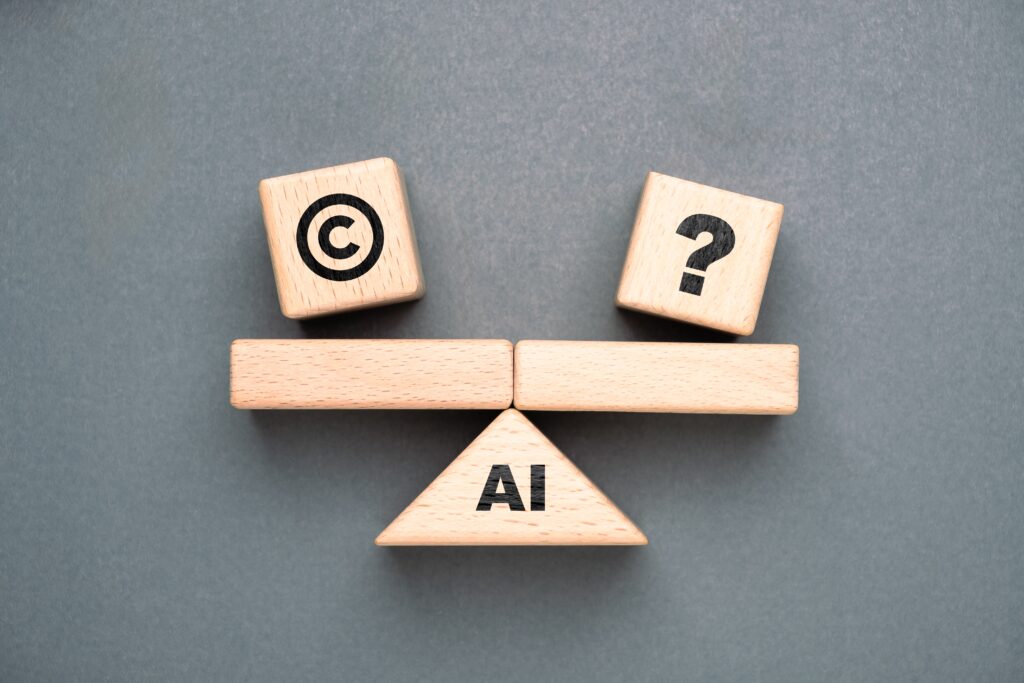
If AI wrote it and no human meaningfully shaped it, you probably do not own it, at least not in the United States. That matters more than most marketing teams realize. A blog post, an ad image, an ebook or a product description produced mostly by AI may be content any competitor can copy, with little you can do about it.
I am not a lawyer in the United States. I trained and practiced as a lawyer before I moved into marketing, and today I spend a lot of my time with AI tools. This article is practical guidance for marketing and business leaders, not legal advice. For decisions about your own content and contracts, talk to your counsel.
Key takeaways
- US copyright requires a human author. On March 2, 2026, the Supreme Court declined to hear Thaler v. Perlmutter, leaving that rule in place.
- AI-assisted work can still be protected, but only the parts a human created, selected, arranged or edited.
- The practical problem is proof: most companies cannot show which parts of their content are human-authored.
- Ideas, methods, processes and product functionality were never protected by copyright, whoever created them.
- Treat AI output as raw material, keep a paper trail for important assets and write an AI usage policy now.
Where US law stands today
The US Copyright Office has long held that copyright requires a human author. A federal appeals court agreed in 2025 in Thaler v. Perlmutter, a case about an image an AI system created on its own, with no human creative input. Stephen Thaler, the computer scientist who built the system, asked the Supreme Court to take the case. On March 2, 2026, the Court declined to hear the appeal.
Two details matter for businesses:
- The Court did not issue a ruling of its own. It refused to review the case, which leaves the appeals court decision and the Copyright Office’s human-authorship requirement firmly in place. In practice, the effect is the same: purely AI-generated work is not protected.
- AI-assisted work can still be protected. What counts is the human creative contribution: what you wrote, selected, arranged, edited and decided. The protection covers those human parts, not the parts the machine produced on its own. The Copyright Office explains its approach in its report Copyright and Artificial Intelligence.
The Catch-22: disclosure versus ownership
Regulators, platforms and clients increasingly expect companies to disclose how they use AI. Disclosure is the right instinct, and in many contexts it will become a requirement. But it creates an uncomfortable tension: the more clearly you say “AI made this”, the harder it becomes to claim that you did.
In practice, the problem is not the legal theory. It is proof. Imagine a competitor copies your flagship guide, your campaign visuals or your product page, and you decide to claim the human-authored parts. Can you show which parts those are? Most companies cannot. They have no record of the prompts, no version history and no trail of edits that shows the human decisions behind the final work.
The distinction between “AI-generated” and “AI-assisted” is clear on paper. In a dispute, without documentation, it is hard to defend. Industries that live on intellectual property, such as film and music, solved a similar problem long ago by archiving drafts, sources and final masters. Marketing teams now need the same habit.
What copyright never protected anyway
One correction to a common fear, including one I made in my own early posts on this topic. Some valuable business assets are not protected by copyright no matter who creates them, human or machine:
- product features and functionality;
- algorithms, methods and systems;
- testing procedures, processes and protocols.
US copyright law explicitly excludes ideas, procedures, processes, systems and methods of operation (17 U.S.C. § 102(b)). Those assets are protected, if at all, by patents, trade secrets, trademarks or contracts. So the AI question matters most for expressive assets: copy, images, video, music, design and the wording of your documentation.
The rest of the world is not aligned
If you market internationally, expect different answers in different places:
- United Kingdom: UK law has a specific provision for “computer-generated” works, which assigns authorship to the person who made the arrangements for the work to be created.
- European Union: there is no specific rule on AI authorship yet, and courts lean toward requiring human creativity. The EU AI Act focuses on transparency, including obligations for providers of general-purpose AI models around their training content.
- China: a Beijing court granted copyright to an AI-generated image, finding enough human input in the way the prompts were written and the results selected.
The direction of travel is the same almost everywhere: the more visible the human creative choices, the stronger your position.
Copyright is not the only AI risk in your marketing
Ownership is the question nobody asks. Several others get asked too late:
- Client data in prompts. Pasting personal data or confidential client information into an AI tool without a data processing agreement can breach GDPR, NDAs or professional confidentiality obligations. Professional services firms are especially exposed.
- Training data disputes. AI providers have paid large settlements and fines over how training data was collected and processed. That is a reminder that the legal ground under these tools is still moving.
- Made-up facts. AI can produce confident, wrong statistics. Publishing them, or putting them in a client report, is a quality failure and potentially a liability.
- Existing rules still apply. Accessibility requirements, advertising rules and endorsement guidelines apply to AI-produced pages and ads exactly as they do to anything else.
What I recommend marketing teams do now
We are practitioners, not legislators. Our job is to reduce risk with the rules that exist today, not to wait for courts to settle every question. Six steps cover most of it.
- Treat AI output as raw material, not finished work. A human should meaningfully write, edit, select and decide. That protects ownership, and it protects quality: AI is an excellent thinking partner and a poor final editor.
- Keep a paper trail for important assets. For anything you would want to defend, such as flagship content, brand assets and campaign creative, save the prompts, drafts, version history and the final human edits. A shared folder and a simple naming rule are enough to start.
- Write an AI usage policy. Cover which tools are approved, which data must never go into them, who reviews AI-assisted work before it ships, and how you disclose AI use. Keep it short enough that people actually read it.
- Check your contracts. Who owns AI-assisted deliverables from your agencies and freelancers? What do they disclose to you about their use of AI? Your clients increasingly ask the same questions of you, so have the answers ready.
- Decide on disclosure deliberately, with counsel. Do not avoid transparency to protect ownership. Do decide in advance what you disclose, where and how, so your approach is consistent and defensible.
- Keep humans accountable for facts. Someone with a name verifies every number before it is published or sent to a client. “The AI said so” is not a source.
A simple test before you publish
Before an important AI-assisted asset goes live, ask three questions. Could we show what a person contributed, if we had to? Did a person check every fact and claim? Would we be comfortable if the client or a regulator asked how this was made? If the answer to any of them is no, the asset is not ready.
Frequently asked questions
Can I copyright content I created with ChatGPT or Claude?
In the US, you can protect the parts you meaningfully created, selected, arranged or edited. Text or images produced by the AI without meaningful human creative input are not protected.
Should we stop disclosing AI use to protect our copyright?
No. Transparency builds trust and is increasingly expected or required. Instead, document the human contribution so you can defend your work, and agree on a disclosure approach with your counsel.
Does this mean competitors can copy our AI-assisted website?
They may be able to copy purely AI-generated parts without infringing copyright. Other protections, such as trademarks for your brand and contracts with partners, still apply. The more human authorship your content has, the stronger your position.
The bottom line
AI is a strong thinking partner. It can retrieve, organize and draft. But the work you can own, defend and stand behind is the work where human judgment is visible. If your team uses AI every day and has no written policy for data, review, ownership and disclosure, that is the gap to close first. It is exactly what our AI Governance & Training and Digital Compliance Audit help companies put in place.